Isentropic expansions and choking#
An isentrope connects the specified stagnation state to the states available during an ideal expansion. Evaluating this path before constructing the nozzle establishes the critical state, the outlet velocity, and whether the flow crosses a saturation boundary.
From pressure to velocity and area#
For an outlet pressure \(p_\mathrm{out}\), the equation of state and conservation of total enthalpy give
The selected pressure must represent an expansion with an attainable supersonic outlet state. In a uniform cross-section, continuity gives \(\dot m=\rho VA\). Consequently, the one-dimensional area ratio is
For a planar channel of fixed span, the area ratio equals the width ratio. The relation provides a useful integral interpretation of the design. The characteristic method additionally resolves the nonuniform cross-passage field between the throat and the uniform outlet.
Why a smooth maximum mass flux is sonic#
Along a differentiable isentrope, the Gibbs relation gives \(\mathrm dh=\mathrm dp/\rho\), while the energy equation gives \(V\,\mathrm dV=-\mathrm dp/\rho\). Combining these with \(\mathrm d\rho/\mathrm dp=1/a^2\) yields
A smooth stationary point of \(G(p)\) therefore occurs at \(M=1\). In the usual nozzle expansion it is the maximum mass flux and defines choking. This derivation requires a well-defined derivative at the critical point.
At a saturation boundary, \(G\) can remain continuous but have a corner because its derivative changes discontinuously. If its maximum occurs at this corner, the maximum-flow condition does not require either limiting Mach number to be exactly one. The nitrogen flashing cases in Cioffi et al. [2026] illustrate this distinction. The initial-line construction must account for the state reached downstream of that maximum.
The current critical-state routine first searches for a smooth sonic root and checks its residual. If the apparent root is a jump, it locates the saturation crossing and uses a nearby mixture state. This is a computational procedure for the supported expansion regimes, rather than an exhaustive search for every possible maximum of an arbitrary non-ideal isentrope.
Mach number need not increase monotonically#
Speed increases as static enthalpy decreases, but Mach number also depends on the sound speed. Its differential is
An increase in sound speed can therefore reduce Mach number even while the flow accelerates. Near-critical single-phase expansions can show smooth extrema in \(M(p)\). Wet-to-dry expansions can instead show a discontinuous decrease in Mach number when the sound speed increases at the vapor saturation boundary.
For comparison, a calorically perfect gas with constant \(\gamma\) obeys
Its monotonic pressure–Mach relation does not capture the extrema or jumps just described. Using a locally evaluated \(c_p/c_v\) in this perfect-gas formula does not reproduce a general real-fluid isentrope.
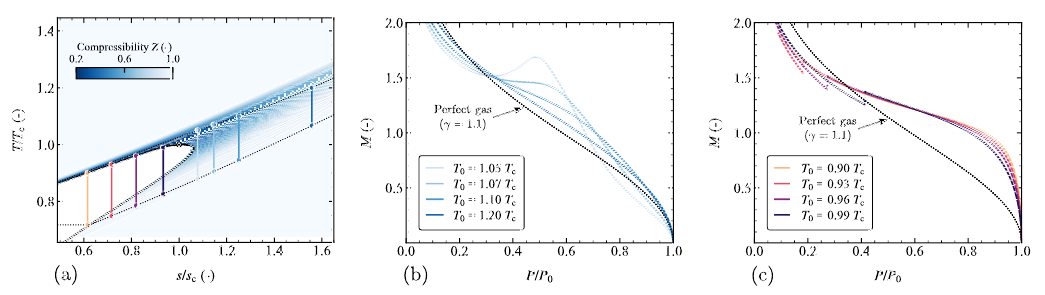
Single-phase and wet-to-dry expansions of MM, extracted from Fig. 1 of Cioffi et al. [2026]. The single-phase paths begin at twice the critical pressure. The wet-to-dry family begins at saturated-liquid states. Read the pressure plots from right to left as the expansion proceeds.#
Two-phase expansion paths#
An expansion starting within the saturation dome can remain two-phase or reach superheated vapor, depending on the fluid and inlet entropy. A subcooled-liquid inlet first follows a single-phase path before entering the dome. The pressure, velocity, and quality histories of these paths determine different nozzle geometries even when the exit Mach number is the same.
For cyclopentane at approximately 2.51 bar stagnation pressure, the stator paper finds that lower inlet quality requires a larger exit-to-throat area ratio and a longer normalized nozzle for the same target Mach number. Changes in quality have a greater effect than the temperature variations examined in that study [Cioffi et al., 2026]. These are case-specific trends associated with the mixture density change, rather than a universal ordering for all fluids.
The guide uses cyclopentane to illustrate expansion within the dome, MM for wet-to-dry behavior, and nitrogen for flashing. The latter two mechanisms are developed in saturation crossings.
Selecting the design target#
If \(M(p)\) is non-monotonic or discontinuous, a requested Mach number can identify
multiple pressures on the same isentrope. Specifying pressure selects a state
more directly. For this reason p_back is the preferred input for
design_nozzle, and the minimum-length solver requires it to determine the
expansion-fan turning angle. When both pressure and Mach targets are supplied,
the API computes the design Mach number from the pressure target.
Here p_back defines the target for a newly generated contour. It does not ask
the package to solve the flow in a fixed nozzle at a changed operating pressure.