Expansions across saturation boundaries#
Crossing a saturation boundary changes the acoustic response of an equilibrium fluid. The resulting change in Mach angle affects the characteristic net, and can also change how the nozzle calculation is initialized. The relevant distinction is whether the sonic transition is smooth and whether the flow remains supersonic on both sides of the phase boundary [Cioffi et al., 2026].
Wet-to-dry expansion#
A wet-to-dry expansion begins inside the saturation dome and reaches superheated vapor. In the MM examples considered in the conference paper, the sonic transition occurs within the mixture before the vapor saturation line is reached. The flow remains supersonic across that boundary, so characteristic marching remains applicable on both sides.
At the boundary, pressure and velocity can remain continuous while the sound speed increases discontinuously. Since \(M=V/a\), the Mach number decreases abruptly and the Mach angle increases. This changes the directions of characteristics that intersect the boundary and can cause neighboring characteristics to cross.
The paper allows this crossover during the characteristic construction and describes removing the resulting fold when processing the wall contour. The construction resembles techniques used to handle weak shocks in characteristic methods, but the equilibrium saturation crossing is not itself evidence of a shock. A physical shock requires the appropriate conservation jump conditions and entropy increase; a jump in \(M\) caused solely by sound speed does not imply either a pressure jump or entropy generation.
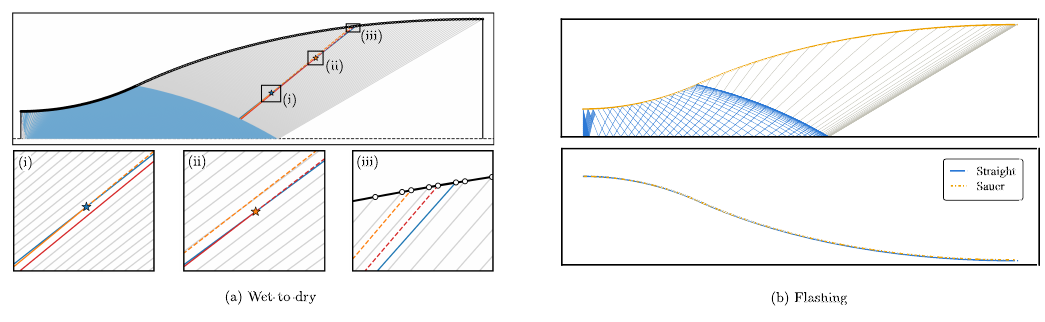
Characteristic grids extracted from Fig. 3 of Cioffi et al. [2026]. The left panels show local crossings near the wet-to-dry boundary. The right panels compare nozzle contours initialized with a straight line and a Sauer line for the low-subcooling nitrogen case.#
Review note — folded wall and property interpolation
The conference manuscript does not specify a complete fold-removal algorithm.
The current conventional solver projects its retained characteristic line to
form wall_final; a dedicated implementation of the paper’s fold correction
has not been identified. Locate the intended procedure and check its effect
on the exported contour. Also check interpolation around the phase boundary:
the present property tables use cubic splines, which do not represent an exact
jump unless the two sides are treated separately. A visually smooth contour
alone does not resolve these questions.
Flashing with a smooth sonic transition#
A flashing expansion starts from subcooled liquid and enters the two-phase region at the liquid saturation boundary. The inlet degree of subcooling is
For nitrogen at \(p_0=20\) bar and \(\Delta T_\mathrm{sub}=2.5\) K, the conference paper finds that the flow is still subsonic immediately after entering the dome. The mass flux continues to increase until a smooth sonic state is reached within the mixture. The saturation crossing therefore precedes the MoC starting region, and a smooth-sonic initialization can be used.
The paper compares straight and Sauer initial lines for this particular case and finds very similar nozzle contours. This comparison illustrates the small influence of the initial-line choice in that case; it does not establish their equivalence for all throat curvatures or inlet conditions.
Flashing through a discontinuous critical state#
At greater subcooling in the same nitrogen study, the maximum mass flux occurs at the liquid saturation boundary. The sound speed falls enough that the limiting Mach number changes from below unity to above unity without passing smoothly through \(M=1\). As shown by Eq. (3), a maximum at a corner of the mass-flux curve is compatible with this behavior.
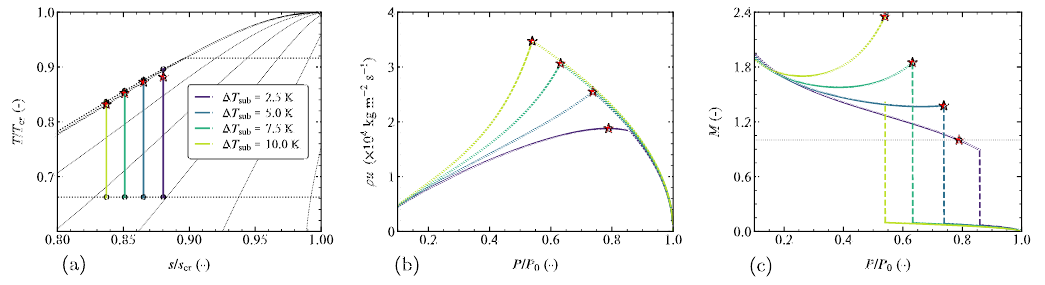
Nitrogen flashing expansions from 20 bar, extracted from Fig. 2 of Cioffi et al. [2026]. The stars identify critical states. In the middle panel the original notation \(\rho v\) denotes the mass flux \(G=\rho V\) used here. The 2.5 K case reaches a smooth sonic state after the saturation crossing; the other illustrated cases choke at the crossing.#
The Sauer perturbation assumes a neighborhood of sonic flow, so it cannot be continued through a finite subsonic-to-supersonic jump. The adopted approximation is a flat initial front with the downstream mixture state. The initial velocity is parallel to the nozzle axis, and the characteristic field is built entirely on the supersonic side.
The straight front introduces a short region near the axis in which the flow has not yet responded to the wall expansion. This accounts for the nearly constant initial portion of the axial solution described in the conference paper. Its extent and sensitivity to initialization should be assessed when using a contour generated from this approximation.
Applying these distinctions#
Expansion path |
Critical transition |
Initial construction |
|---|---|---|
Single-phase or within-dome expansion with a smooth sonic state |
Continuous passage through \(M=1\) |
Smooth-sonic initialization; a flat approximation is also available |
Wet-to-dry example with a supersonic vapor-boundary crossing |
Smooth sonic state upstream of the crossing |
Initialize upstream, then account for characteristic crossover |
Low-subcooling flashing example |
Entry into the mixture remains subsonic; choking follows |
Initialize at the subsequent smooth sonic state |
Flashing with choking at the liquid saturation boundary |
Finite jump from \(M<1\) to \(M>1\) |
Flat downstream front |
These categories describe the paths examined in the papers. If a candidate path becomes subsonic within the region to be marched, the supersonic MoC construction no longer applies there. Likewise, equilibrium geometry does not resolve delayed flashing or phase slip. Such effects belong to the subsequent flow analysis.
The nozzle example uses the nitrogen flashing conditions, while the stator example uses cyclopentane with a two-phase inlet.