Extruded surface: a full cylinder#
Extruding a full unit circle along the \(z\) axis produces the cylindrical surface
The cylinder has radius one and height two. This example constructs the entire lateral surface, with coincident boundaries at \(u=0\) and \(u=1\). Its two circular ends remain open.
Inputs#
CircularArc represents the full \(2\pi\) circle exactly with four
rational quadratic spans. Use its .NurbsCurve attribute as the input
to nurbspy.nurbs_surface_extruded.NurbsSurfaceExtruded.
The circle has three coordinate rows because the extrusion is spatial,
even though the initial profile lies in the \(xy\) plane.
The extrusion helper normalizes D and uses d as the extrusion
distance. Its .NurbsSurface attribute exposes the resulting surface.
Here \(u\) follows the circle, while \(v\) follows the vertical extrusion.
Complete script#
Run python demos/documentation/extruded_surface.py, or
download the script.
"""Extrude a full rational circle into an exact cylindrical surface."""
import numpy as np
import matplotlib.pyplot as plt
import nurbspy as nrb

nrb.set_plot_options()

circle = nrb.CircularArc(
    O=np.array([0., 0., 0.]),
    X=np.array([1., 0., 0.]),
    Y=np.array([0., 1., 0.]),
    R=1., theta_start=0., theta_end=2 * np.pi,
).NurbsCurve
surface = nrb.NurbsSurfaceExtruded(
    C=circle, D=np.array([0., 0., 1.]), d=2.
).NurbsSurface

uu, vv = np.meshgrid(np.linspace(0., 1., 41), np.linspace(0., 1., 31),
                     indexing="ij")
S = surface.get_value(uu.ravel(), vv.ravel())
H, K = surface.get_curvature(uu.ravel(), vv.ravel())

print("Control net shape:", surface.P.shape)
print(f"Degrees: ({surface.p}, {surface.q})")
print(f"Maximum cylinder radius error: {np.max(np.abs(np.hypot(S[0], S[1]) - 1.)):.2e}")
print(f"Maximum height error: {np.max(np.abs(S[2] - 2 * vv.ravel())):.2e}")
print(f"Maximum Gaussian curvature magnitude: {np.max(np.abs(K)):.2e}")
print(f"Maximum |H| error from 0.5: {np.max(np.abs(np.abs(H) - 0.5)):.2e}")
v = np.linspace(0., 1., 31)
seam_error = np.max(np.abs(surface.get_value(np.zeros_like(v), v)
                           - surface.get_value(np.ones_like(v), v)))
print(f"Maximum seam mismatch: {seam_error:.2e}")

fig, ax = surface.plot(surface_color=nrb.COLORS_MATLAB[0],
                       isocurves_u=13, isocurves_v=5, Nu=101, Nv=41)
ax.set_title("Full cylinder by extrusion")
ax.set_box_aspect((1, 1, 1))
ax.view_init(elev=25, azim=35)
# Leave room for the 3D axis labels when displaying or exporting the figure.
fig.set_size_inches(7, 6)
fig.subplots_adjust(left=0.05, right=0.85, bottom=0.15, top=0.9)
ax.set(xlabel="$x$", ylabel="$y$", zlabel="$z$")
for axis in (ax.xaxis, ax.yaxis, ax.zaxis):
    axis.labelpad = 4
plt.show()
Output#
The control net has shape (3, 9, 2) and degrees \((2,1)\).
Both rows of weights are inherited from the circle. At every sample
\(x^2+y^2=1\) and \(z=2v\), up to floating-point roundoff. The script also
checks that the two sides of the circumferential seam coincide.
A unit cylinder has Gaussian curvature \(K=0\) and mean-curvature magnitude \(|H|=1/2\). The sign of \(H\) depends on the surface normal. The script prints the errors against these geometric properties.
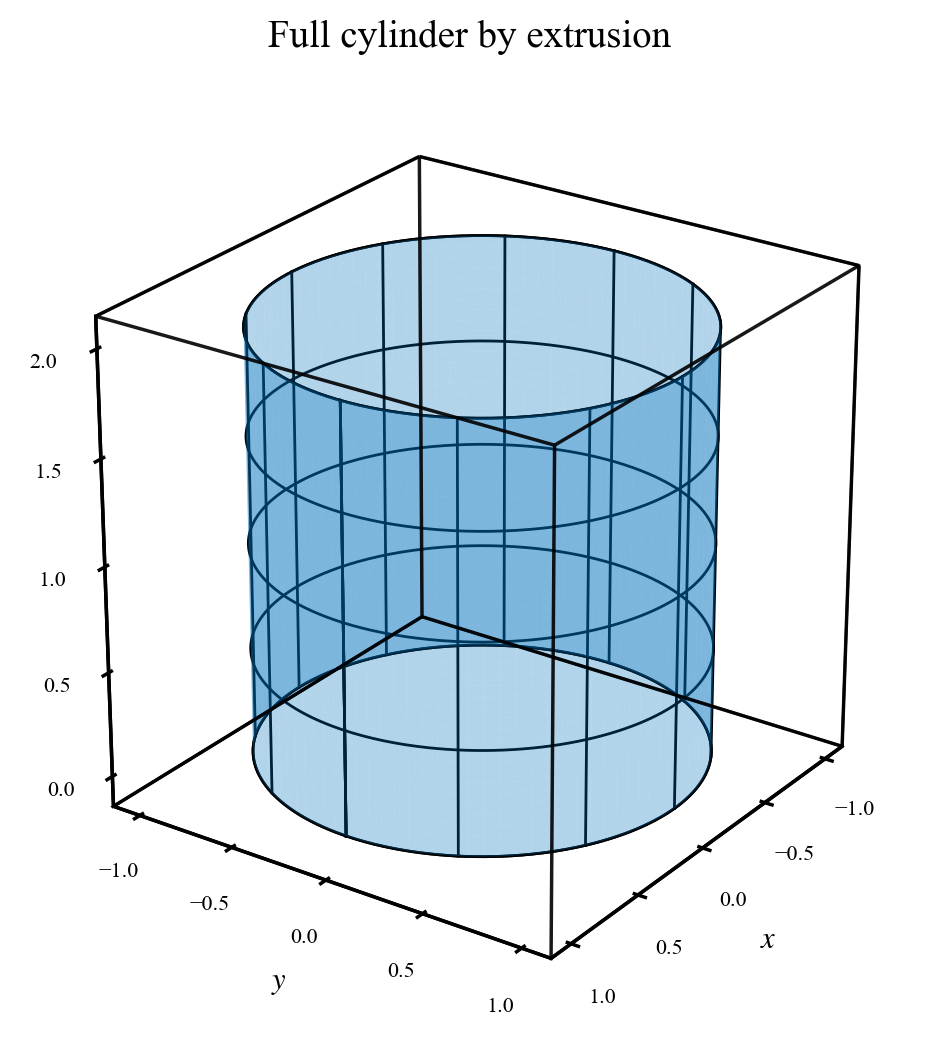
An exact circular profile extruded in a straight line produces a full cylinder.#
The package’s surface.plot() method draws the cylinder and its
isoparametric curves. Setting control_points=True also displays the
two rings of control points.